


FoodSub
Healthy fast food options to be easily available
Role
UX Designer responsible for research, ideation, visual design and testing
Duration
2.5 months
Team
4 design students
Tools & Methods
Google Scholar, Miro- Secondary Research, Observations
Whiteboard- Ideation
Adobe XD- Prototyping
Zoom- User Interviews
MS Word, Google Docs- Usability Evaluation
Overview
Our main goal was to understand food's impact on people's health and their lives. Though the importance of health has been imbibed in every one of us since childhood it is still the biggest concern in the world.
From that, we found that the National Health and Nutrition Examination Survey says- that around 37% of people in America eat fast food which is about 85 million people in a day. Thus we started to revolve our study around adults living in the US.
PROBLEM
Even though people are aware of the harmful effects of fast food on their health, what makes them still choose fast food over healthy food is still unexplored to its maximum extent.
Design Challenge
"How might we help people avoid eating Fast Food and help them make healthier choices?"
Solution
The design solution is being addressed through a mobile application called "FoodSub".
It is a food-ordering mobile application and its aim is to provide healthy food substitutes to users helping them make conscious choices as they eat fast food, tailored to their preferences.
Take a look at the prototype 👉🏼


User Research
We started to explore by looking at the different kinds of food, advantages, disadvantages, and addictions. While doing that we came across people's routines of eating food, especially fast food. That is when we started to look up more at the fast-food topic before deciding upon the problems that needed to be addressed.
While looking at fast food we had the thought of changing our perspective to eating healthy food as well as their eating habits and then decided to discover more about it.
In this phase, we conducted a secondary review, observations, and interviews to find out more.
Secondary Review
To understand how fast food is impacting people in the United States, we conducted secondary research by going through various research papers that have tried to address this issue. We came across the below-mentioned information that provided more insight.
8 out of 10
people in the United States eat fast food once a month, and 47% eat fast food once a week or more
22.7%
Breakfast
43.7%
Lunch
42%
Dinner
Percentage of Fast food meals commonly consumed every day by the people
We viewed the adverse effects on a human's health if fast food becomes an addiction. We understood that when consumed in excess, it is associated with a number of health issues, both physical and mental.
-
Physical health-related issues are high blood pressure, Type 2 diabetes and heart diseases, obesity, and many more.
-
It can cause mental issues like psychiatric distress and violent behaviors among children.
The main reason behind getting addicted to fast food
.png)
This suppression creates a false sense of deficiency of the dopamine effect, and to compensate for it, people tend to go for even more fast food.
Observations & Interviews
We conducted 8 observations at various food joints such as Subway, Blaze Pizza, Papa John's, IUPUI Campus center food court( Chick Fil A, Panda Express), Starbucks, and a confectionery store called Rocket Fizz.
We then prepared an interview protocol according to the data gathered during secondary research and observations and went out to interview 8 people in total.
Insights from Observations and Interviews
Some people tend to go for healthy options but eventually pair them up with fast food items.
Easy availability of intended food items and time constraints are factors that restrict people from changing their food goals.
There is a sense of unavailability as people are unaware of local food options especially when they relocate to new places.
People like to have their own choice of food mainly because of their taste preferences and satisfaction with hunger.
What Users Say

“We are humans. We may get cravings for junk food. It is okay to treat ourselves occasionally. But it is important to keep control and get good habits for ourselves.”
Problem Synthesis
This stage was a crucial one as it helped us define the insights gathered from our user research.

Figure- Affinity Mapping on miro board
We performed Affinity mapping by consolidating the data gathered from secondary reviews, observations, and interviews onto the MIRO board.
While grouping I was able to find similar patterns and classify them. This helped us frame our key problems.
We also created an Empathy map in order to focus on the user's thoughts, feelings, statements, and other related mannerisms.

Figure- Empathy map on miro board
Identified problems

Choice of food has more priority

Desire to eat a food item

Compromising to eat in order to cook

Habit of eating fast food

Aware about fast food's cons

Lack of control over their food

Availability problems based on different factors

Not taking health as a first priority
Personas
Using affinity mapping and empathy maps, we were able to put together 2 personas based on the insights gathered from them. It also helped us shape 2 kinds of users in order to address our key problems.


Brainstorming & Ideation
We performed the brainstorming activity in 3 sessions:
-
Individually
-
Among team members
-
With another team who did not know in depth about our project
In all the sessions we generated many ideas with a broad scope. This collection of solution ideas was narrowed down on the basis of 3 requirements:
-
User's pain points as mentioned in both the personas
-
Technological feasibility
-
Economic feasibility
Our requirements made us decide what pain points should be addressed in our solution.
We decided to focus on the following:
1. Availability of nutrition-rich food
2. Variety of options
3. Change in people's habits
4. Awareness
Thus, we ended up forming our solution by combining two to three small ideas together to make one whole idea to solve our most imminent need, FoodSub.

Figure- Brainstorming different ideas for the solution

Figure- Ideation of application flow
Storyboarding
Creating use-case scenarios based on real-world situations and personas was instrumental in our decision-making process for the final design solution. This allowed us to gain a better understanding of how the solution would operate once implemented.
Scenario 1

Figure- Use case scenario for Ramsay
Scenario 2
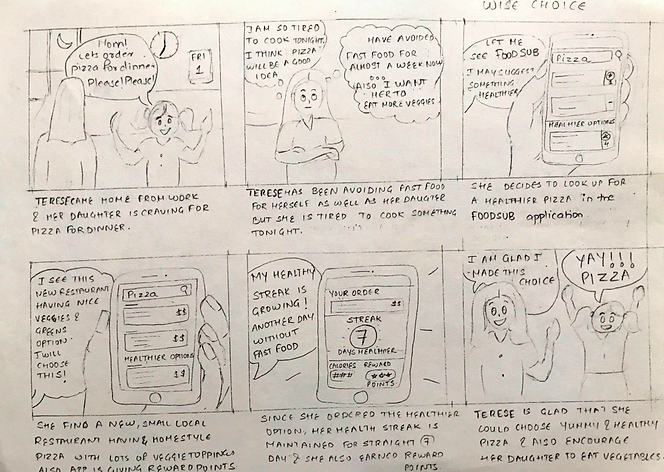
Figure- Use case scenario for Terese
Final Design Solution
FoodSub’s aim is to provide healthy food substitutes to users helping them make conscious choices as they ate fast food.
1. FoodSub is a food ordering mobile application.
2. Suggests nutrient-rich substitutes by taking information from the user about their dietary preferences.
3. Then provides selected food items tailored to their preferences, needs, and restaurant availability.
4. Also provides additional information about the benefits and nutritional facts of nutrient-rich food items.
5. Additional rewards are also presented, associated with the substitutes.
Prototyping
Low-fi prototypes
After ideating on our final design solution we started to make low-fidelity paper wireframes with respect to the features decided. This was a vital step in helping us create the main flow of our application.
Healthy food indication

Figure- Search results screen

Figure- Restaurant screen

Figure- Nutritional details screen
Substitute options

Figure- Select Options screen

Figure- Option 1 screen

Figure- Option 2 screen
Related features

Figure- My cart screen

Figure- Order placed screen

Figure- My coins screen
Final prototype solution
By testing our low-fidelity paper prototypes with some users, we got many insights, and those incorporated them to form our final high-fidelity prototypes.


Onboarding
Food-related information of the user is taken to help determine what kind of choices can be provided.
Healthy heart symbol
The green heart symbol identifies that the restaurant has nutritional-rich healthy options available.


Healthy heart symbol in relation to coins
The green heart symbol is clickable indicating that a food item is a healthy option in that restaurant and coins are rewarded to the user if they buy that healthy food option.
Nutritional Information
The green heart symbol when clicked opens this pop-up that provides all nutritional-related details about that food item.

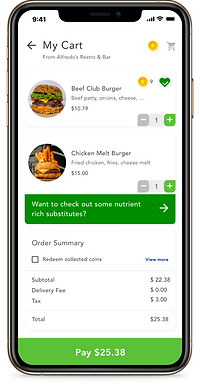


Options for substitution
This provides a way to check out more nutrition-rich options without a need to compromise on your taste by selecting from either of the two options.
Substituting food item
This option provides suggestions for whole food items with healthy and nutritive-rich alternatives according to the availability in the restaurant.


Substituting food item ingredients
This option provides suggestions for the food item's ingredients with healthy and nutritive-rich alternates according to the availability in the restaurant.
Rewards
The rewards i.e. my coins screen provide in detail history about the restaurant from which they were received and other offers to redeem.

Usability Evaluation
Heuristic evaluations were done as a part of self-reflective evaluations. Along with this, to get a real-world user's point of view, we also did the Think Aloud evaluation exercise with four users.
Heuristic evaluation
We followed Jacob Neilson’s 10 heuristic principles for evaluating our application. Here are the passes and falls of the application-
What was liked
-
Less jargon used
-
Good consistency
-
Aesthetic and minimalist design
What needs to be improved
-
Error prevention
-
No help and introductions about new features
-
Less flexible to use
Think Aloud
We performed the Think-Aloud activity where the users were briefly explained the application goals and asked to talk about every thought and decision while performing the steps.
Outcomes
-
The question format needs to be clear and suggestive.
-
Unable to recognize the relation between coins and the healthy heart symbol.
-
Substituting a dish was not understood while selecting that option.
-
Information about a healthy food items was very helpful and different
-
The heart icon was interpreted as favorites and the coins icon was interpreted as ratings.
-
Discrepancies between the written statements in the application and the user's interpretations.
Future scope
We understood that to improve our design solution we would need to incorporate some changes in the design solution.
-
Redesign the onboarding screens by performing more research on the dietary needs of various users and arrive at a common point that would address all users equally.
-
Considering other nutritional concerns too such as food inclusions related to carbs, sugar, and salt with respect to users.
-
Increasing the customer order to a group aiming at users’ habit-building when they go on to eat fast food.
-
Encouraging restaurants to include healthy alternatives in their menu for users thus promoting healthy fast food and its availability.
-
Encouraging people to opt for healthy available fast food options having the same taste to help them in the longer run.
Learnings
FoodSub is the first design and academic project where I worked through each step of the UX design process. It was a great design thinking experience filled with knowledge as I got to explore different aspects, ways, and approaches to a problem statement.
This design challenge was a sensitive topic but we as a team got through the hurdles as we reached the final solution. Brainstorming and ideation were the key areas (also my favorites in the process) that helped model the solution whereas evaluations helped us justify our design to the users and personally made me understand the importance of it.
I thoroughly enjoyed working as a team and got to use new design methods such as storyboarding, heuristic evaluations, and thinking aloud which in turn helped me to be provocative.
Thank You for reading!
If you want to continue exploring more of my work 👇🏼